Internal Tax Control Framework (ITCF)
The objective of the Internal Tax Control Framework (ITCF or the framework) is to ensure tax compliance within the organisation.
Data publikacji: 6/25/2026
Data aktualizacji: 6/25/2026
The ITCF is a set of processes, procedures, tools, and resources supporting effective supervision over tax matters within the organisation.
The framework applies to the entire organisation, as the proper fulfilment of tax obligations is the result of multiple processes taking place within the organisation, at both the strategic and operational levels. Therefore, the framework covers the following areas:
- Tax strategy,
- Organisational culture,
- Tax governance,
- Organisation of the tax function,
- Tax risk management,
- Internal control,
- Internal audit,
- Human resources management within the tax function,
- Support of information technology (IT) tools within the tax function,
- Tax information and data management,
- External supervisory mechanisms.
The ITCF has been presented in graphical form:
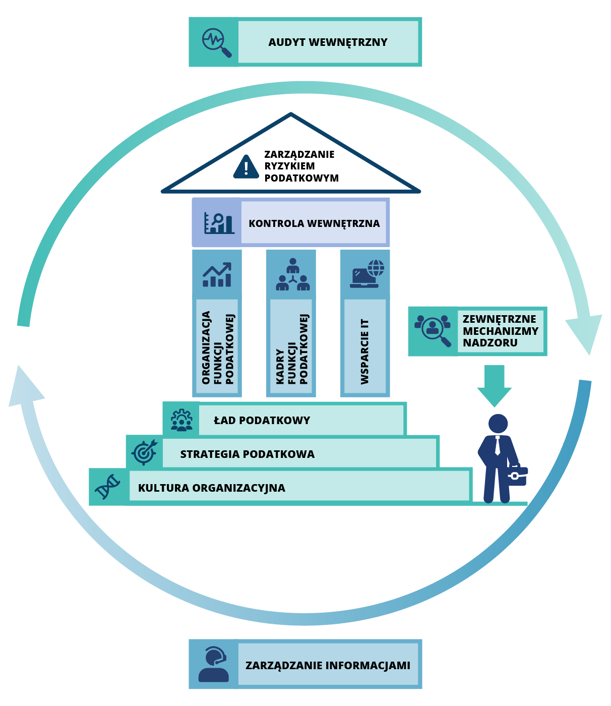
Internal Tax Control Framework – text version
The graphic depicts a house, whose gable roof features the inscription: "tax risk management", next to which is a white exclamation mark on a navy blue triangle.
The body of the house consists of a horizontal column placed under the roof with the inscription: "internal control". It rests on three pillars of equal thickness bearing the following inscriptions:
- the first pillar contains the inscription: "organisation of the tax function",
- the second pillar contains the inscription: "human resources within the tax function",
- the third pillar contains the inscription: "IT support".
These three pillars rest on the foundations of the house, which form three steps, each subsequent step being wider than the previous one:
- the first contains the inscription: "tax governance",
- the second contains the inscription: "tax strategy",
- the third contains the inscription: "organisational culture".
Next to the house stands a man with a tie and a briefcase; above his head is the inscription: "external supervisory mechanisms".
The whole structure is surrounded by two arrows accompanied by the inscriptions "internal audit" and "information management".
The areas of the ITCF are closely related and mutually interpenetrate. The implementation of appropriate tax control mechanisms in individual areas of the organisation's functioning influences the efficiency of these mechanisms in other areas. Therefore, ensuring the appropriate quality of supervision in all areas produces a synergy effect in the form of a mature, i.e. effective and adequate, ITCF.
Thanks to a mature ITCF, the organisation can effectively monitor and control tax processes and consciously manage tax risks, identifying potential threats and minimising the possibility of their occurrence, thereby increasing the organisation's credibility in the eyes of business partners and tax authorities.
The functioning of the Cooperative Compliance Programme is based on the concept of justified trust introduced by the OECD, which assumes that the taxpayer will implement an effective and adequate ITCF, thanks to which they are able to supervise themselves regarding tax matters.
Therefore, in the Cooperative Compliance Programme, the level of NRA supervision depends on the quality level of the ITCF. The more mature it is, the higher the level of trust the NRA has in the taxpayer and, consequently, the less it supervises them.
Consequently, one of the fundamental obligations of a taxpayer who has signed a cooperation agreement is to have an effective and adequate internal tax control framework (Art. 20u, point 2 of the Tax Ordinance Act).
Bearing the above in mind, the Ministry of Finance, while preparing for the implementation of the Cooperative Compliance Programme, developed the Guidelines on the Internal Tax Control Framework (Guidelines) in 2019. This document was developed as a result of the conducted tax consultations.
Guidelines:
- constitute a description of the framework requirements regarding the taxpayer's internal organisation and activities within the scope of the tax function;
- are a set of principles defining the internal and external relations within the enterprise, their organisation, the functioning of internal supervision, and key internal systems and functions, as well as statutory bodies and the rules of their cooperation regarding internal control over the risk related to proper tax settlement.
It should be emphasised that these Guidelines are not legally binding, and their implementation is voluntary.
An entity applying to the Cooperative Compliance Programme should have an effective and adequate ITCF implemented. However, the framework may be implemented in a manner different from that described in the Guidelines. Therefore, the Company applying to the Programme should, in accordance with the comply or explain principle, indicate the reasons for deviating from a given requirement and whether another alternative solution has been implemented, or whether changes in a given area are planned in the future.
Document for download:
 Wytyczne w zakresie Ram Wewnętrznego Nadzoru Podatkowego PDF, 973.05 kB
The objective of the internal tax control framework maturity assessment model (the model) is to provide objective, reliable information allowing for the assessment of its quality level.
The model also aims to build taxpayers' awareness regarding the scope of the ITCF and the elements essential for ensuring its effectiveness.
The model determines the path of gradual development of the internal tax control framework. This development should be adapted to the capabilities and maturity level of the organisation in other spheres of its activity, so that the development of the ITCF is consistent with the development of the entire organisation.
The assessment of the ITCF conducted using the model serves as an indication allowing the determination of the maturity level of the supervision over tax matters implemented by the taxpayer, as well as the actions that still need to be taken to improve this supervision.
One of the main objectives of implementing the aforementioned model is to facilitate the process of preparing for and applying to the Cooperative Compliance Programme, through:
- the possibility for the taxpayer to conduct an objective self-assessment of the ITCF maturity level,
- ensuring the transparency of the principles of its assessment,
- clearly defining the minimum requirements regarding the quality of the framework that should be met by a participant in the Programme.
At the same time, it should be emphasised that this model can be applied not only by an entity applying to the Cooperative Compliance Programme, but by any enterprise that wants to assess and develop the ITCF within its organisation.
A five-level maturity scale has been introduced in the model:
- level 1 – ad hoc
- level 2 – initial
- level 3 – defined
- level 4 – managed
- level 5 – conscious
The higher the maturity level of the ITCF, the lower the probability of the taxpayer undertaking actions resulting in tax irregularities. The assessed entity's ability and willingness to properly fulfil tax obligations are greater, which translates into a higher level of trust and less supervision from the NRA within the Cooperative Compliance Programme.
The internal tax control framework can be considered effective and adequate starting from the third level. Therefore, an organisation that wishes to join the Cooperative Compliance Programme should achieve a maturity level close to the defined level (level 3). On the other hand, if an organisation achieves values between level 2 and level 3 as a result of the preliminary audit, it will have the opportunity to supplement the missing elements after signing the cooperation agreement, within a timeframe agreed upon with the NRA.
A significant aspect of the maturity level is also the organisation's readiness and willingness for the continuous development of the ITCF. This means that an organisation that has achieved level 3 maturity should work towards the further development of the ITCF.
For each of the ITCF maturity assessment levels, a general characterisation has been prepared, which can be found in sheet no. 2 and next to each of the maturity levels in individual areas of the model. The general characterisation of the ITCF maturity levels serves as a point of reference for the organisation in case of doubts as to which level the implementation of not only the entire ITCF, but also individual areas or specific requirements resulting from the Guidelines, should be assessed.
Similarly to the Guidelines on the ITCF, the model is not normative in nature. It constitutes a set of expected, rather than obligatory, solutions. Therefore, when making an assessment based on the model, the comply or explain principle should be applied.
The model adopts the principle of moving from the specific to the general; therefore, the maturity of individual attributes is assessed first, followed by the areas, and finally the entire ITCF.
When conducting the ITCF maturity assessment, it should also be borne in mind that not every attribute requires formalised, written regulations in the form of a document (it is important that the rules of procedure in a given process are documented, however, the manner of their documentation may vary).
An entity applying to the Cooperative Compliance Programme should justify the assessment made for each attribute, indicating specific actions taken by the organisation in this regard.
It should also be clarified that in the model, similarly to the Guidelines and good practices regarding the ITCF described below – two elements of the ITCF, i.e. tax information and data management as well as internal audit, have not been distinguished as separate areas. They constitute integral components of other ITCF areas and have been incorporated into them. The role of internal audit regarding tax matters is the independent monitoring, verification, and assessment of the effectiveness of processes, including, inter alia, tax risk management, internal control, and tax governance. Consequently, internal audit supports the functioning of individual ITCF areas through an independent perspective on their functioning and their assessment, which may serve to improve them. Similarly, communication and information permeate every area of the ITCF, influencing their quality. Therefore, the aforementioned ITCF documents have been divided into 9 areas.
n case of any questions and comments regarding the model, please contact us at the indicated email address:
program.wspoldzialania@mf.gov.pl
Document for download:
The “Guidance and good practices for RWNP” document supplements the documents described above.
The objective of this document is to present guidelines and best practices for the implementation and functioning of individual elements of the ITCF, as well as improving their quality.
The guidelines and best practices presented in the document constitute only examples of possible solutions, referring both to the 3rd level of ITCF maturity and higher levels. Therefore, they should not be interpreted as a standard or a checklist of solutions required for implementation by organisations applying to the Cooperative Compliance Programme.
This document also indicates examples of poor practices and the most frequently encountered mistakes made by the organisation regarding the implementation and functioning of the ITCF.
The sources of information for the preparation of this document included, inter alia, solutions implemented by entities applying to and participating in the Cooperative Compliance Programme, as well as documents published on websites by key entities and multinational corporations. Another source utilised to prepare this material consists of good practices published by other revenue administrations and tax advisory firms.
The document will be periodically updated to provide the best possible support for organisations seeking inspiration and guidance in improving the quality of the ITCF. Therefore, we encourage you to submit proposals for solutions enhancing the effectiveness of the ITCF to the following address:
program.wspoldzialania@mf.gov.pl
Documents for download:
Wskazówki i dobre praktyki w zakresie RWNP PDF, 2.03 MB
Załącznik nr 1 - Wpływ typu kultury organizacyjnej na RWNP PDF, 93.00 kB
Załącznik nr 2 - Przykładowa matryca RASCI XLSX, 37.26 kB
Załącznik nr 3 - Przykładowe zestawienie obszarów, które powinny być objęte procedurami PDF, 85.11 kB
Załącznik nr 4 - Przykładowy rejestr ryzyk podatkowych XLSX, 21.22 kB